Category Archives: Interviews

A Dog’s Life: Interview with Gowon Fisher

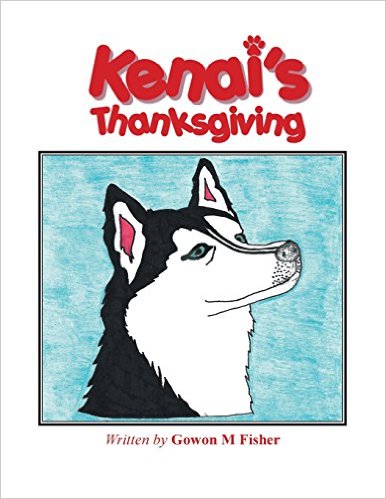
This week’s author spotlight features writer and illustrator Gowon M. Fisher. Gowon writes charming children’s book, including Kenai’s Thanksgiving, which is a sweet tale of holidays and one very curious dog. Recently, Gowon offered a pithy perspective into his life as an artist.

A few icebreakers to start: when did you first decide to become a writer, and who are some of your favorite authors?
I decided to become a writer in 2013. I have always enjoyed drawing, and writing, but 2013 was when I decided to put my ideas into action. I love writing children’s books and was inspired by the works of children’s authors, whose books I read as a child. These authors include William Steig, James Marshall, and Maurice Sendak.

In addition to your writing, you are also an illustrator. What are your favorite mediums as an artist?

I love experimenting with different mediums. In my newest book, the illustrations are done in acrylic paint. However, I also like to do illustrations in colored pencil.

Kenai's ThanksgivingYour children’s book, “Kenai’s Thanksgiving,” is such a wonderful concept. What inspired you to create a book from the point of view of your Siberian Husky? (He’s adorable by the way.)

Kenai’s Thanksgiving was inspired by an actual event that took place on Thanksgiving. I felt that this would make a wonderful children’s story because it is funny, and tells the story from the point of view of Kenai. He lives in a world with such wonders, and is curious about everything!  But sometimes his curiosity leads to chaos.

What projects are you currently working on?

I am working on publishing a new children’s book called The Great Squirrel Rebellion. This story is about a group of squirrels who try to eat seed from a bird feeder. However, the woman who owns the feeder does not want squirrels eating her seed. Only birds. The squirrels devise all manner of tricks to gain seed, and the woman tries her hardest to keep them away. A bitter conflict ensues. However, in the end, both parties learn that compromise is always the best way to solve problems.

In what directions would you like to take your writing career in the future?

In the future, I would like to gain employment as an illustrator of children’s books. Right now, I am just working on getting my ideas out in the public.

Thanks to Gowon Fisher for being part of this week’s author interview series! You can find Kenai’s Thanksgiving at Amazon!

Happy reading!

Bold Beginner: Interview with Lambert Muir

Welcome back to the latest edition of my author interview series! This week, I shine a spotlight on Lambert Muir. Lambert is just starting out in his writing career, but he’s already well on his way when it comes to leaving his mark on the fiction world.

A few icebreakers to start: when did you first decide to become a writer, and who are some of your favorite authors?

Lambert MuirI don’t believe in Fate or Destiny, but I don’t believe I really decided to be a writer either. I was the weird kid at school, distant, always with his head in a book, living in that head most of the time, had maybe one friend. A C student that no one really thought would go on to pursue higher education. BUT! Find me a book that interested me, most often a book that hadn’t been assigned by a teacher, and I could recite it almost cover to cover. Ask me to write something, not just take dictation, a story of my own and I was on it like I was trying to cure cancer, working madly at it. I wrote past the word limit, I wrote stories that didn’t fit the curriculum. Some teachers encouraged me, most asked to speak with my parents or sent me to speak with the counselor.

Flash forward to some years ago, add some punk and puberty, and I made it to the Cinema program at Dawson only to realise that I cannot stand cameras and sound equipments and editing softwares. The whole moviemaking process is like a piano wire spider web and I want my ideas out there faster than it would allow. There’s no way I’m continuing in this field of study on to University. Fortunately, the nice older man working at the comic shop I frequent tells me that [if] I like coming up with stories, why don’t I try and sign up for the Creative Writing program at Concordia? So I cobble up a portfolio a week before deadline and I get in. Once there…Things felt right.

I’ve been shamelessly calling myself a ‘‘writer’’ ever since, because when I write, it feels like the right thing for me to be doing at the time ,and I want to go on writing in some capacity until I die.

As for favorite writers, I don’t really have one. Let’s just say Grant Morrison, or Arthur Conan Doyle, or Hunter S. Thompson and move on.

Is there a particular genre in which you prefer to write?

No. My writing is predicated on the ideas I have when I have them. They appear as flashes, images, sentences, and evolve as I think about them.

If forced to choose, which part of the writing process is your favorite: developing point of view/voice, crafting dialogue, or building conflict?

Again, writing is more a long strange trip for me. Sometimes ideas will come as big story-ready things; sometimes I have to Frankenstein smaller ideas together. But once I have my idea, my story, and what I want to say or do with the story, writing is just a matter of getting to work.

It’s not a perfect process and it results in a lot of beginnings written with ink scattered across quite a few notebooks, unfinished, waiting for something that’ll trigger an idea on what to do with them. Still, it allows for fresh perspectives, new ways of telling the story that I think improve the whole thing. Though, I may just be excusing laziness.

What is best, though, is when you go off. When the actual work of writing is erased by the fun of creating, of coming up with the next bit of the story, when you’re jamming, like, really jamming, going back and forth, writing and rewriting, like…Jamming. I’ve been high, I’ve been drunk, but nothing’s quite like when you just let go and jam your writing. It’s what makes the tenth rewrite tolerable.

The Blasted Tree

What projects are you currently working on? In what directions would you like to take your writing career in the future?

A sci-fi story, maybe a queer love story, a spy story, an autobiographical story about going on the road, a weird detective story…I couldn’t say which will be published first, or which will get worked on next or when, but that’s mostly what’s been in my head this summer.

The way I write is dependent on mood and setting aside time to work, which I wouldn’t recommend to anyone, least of all me, but I recently joined a group of writers online and while it doesn’t ‘‘motivate’’ me per se, it does keep me thinking about writing, consciously or otherwise.

As for the future, my wildest dream would be to write comics. Marvel, DC, creator owned stuff, I love the medium, I’m a fiend for it and I’d love to contribute to its future. I don’t think I’ll stop writing prose though; maybe I’ll even try this poetry thing I keep hearing about…

Any links you’d like to share?

You can find both “Clarity in Darkness” and “Two Fifteen,” my first published work, at The Blasted Tree’s website. The Blasted Tree is a Canadian art collective and publishing company that provides an outlet to the next generation of Canadian artists, writers and poets. If you’re looking for wild stuff produced by mad Canadian children who witnessed the birth of the 21st Century, then look no further.

Big thanks to Lambert for being part of this week’s author interview series!

Happy reading!


Interdisciplinary Iconoclast: Interview with Nicole DeGennaro

For today’s author interview, I’m pleased to introduce Nicole DeGennaro. She’s a speculative fiction writer with stories appearing in numerous anthologies. Her upcoming project called 341 is a fantastic interdisciplinary project that involves both authors and artists in an unusual hands-on way. Plus, Nicole cites both Ray Bradbury and Richard Matheson as her horror inspirations, so there’s no way to deny this author knows her stuff.

Below, we talk about her upcoming project as well as her favorite part of the writing process.

When did you first decide to become a writer, and who are some of your favorite authors?

Nicole DeGennaroTo be honest, it was never a conscious decision that I made. I grew up as a voracious reader (and still am), so I’ve always considered it a natural progression that I would go from reading to writing. A few years ago it occurred to me that people other than my friends and family might like to read my stories, and that’s when I started submitting to anthologies and whatnot.

Some of my favorite authors are Ursula K. Le Guin, Neil Gaiman, Susanna Clarke, and Maggie Steifvater.

Much of your work belongs to the gothic and/or horror genre. When did you first become interested in horror, and do you find yourself returning to certain stories/poems/films for inspiration?

I grew up watching The X-Files (and am SO excited for the new season), and I read some Stephen King when I was relatively young; The Stand is still one of my favorite books. Eventually I branched out into Richard Matheson and Ray Bradbury and other staples of the genre. Like writing in general, writing horror was never a conscious choice for me either; most of the ideas I come up with just naturally take a dark turn!

I re-read The Stand often, but it isn’t exactly for inspiration. I tend to seek new sources of inspiration instead of returning to old ones because I’m always looking for ways to improve and expand my own writing, and I feel a good way to do that is to read new authors and stories. I do sometimes re-read the same short story collections from authors like Matheson and Bradbury because those will offer a lot of variety, which I find can plant new story ideas in my head.

You work in New York City. How does the omnipresent bustle of one of the world’s largest metropolitan areas impact your work (if at all)?

What a great question! New York City is such a large and diverse city; it’s great for people watching. You can get glimpses into lives that are completely unlike your own, and also see the full range of human emotions in a very short span of time (especially during the morning and evening commutes). It’s a great way to learn the nuances of human behavior. So I think being there almost every day has a more general rather than specific impact on my writing.

In what directions do you see the horror genre going in the next ten to twenty years?

I’d like to think it’s going to become more inclusive with regard to author and character diversity. This is already happening, but I hope it continues to do so. I also think that as technology continues to advance, horror will follow that. Like the movie “Unfriended” that came out recently (although I haven’t seen it yet). We’ll see more stories that play on our fears related to social media and technology. But I think the classic staples of the genre, like supernatural creatures and psychological horror, will always be around. They feed into a more primordial fear that I don’t think humanity can escape no matter how far we advance. (I should note that I am terrible at predictions.)

You have three works appearing in an upcoming illustrated short story book. What can you share about this project?

I am so excited about this project! It’s called 341; my girlfriend came up with the idea a few years ago, and we asked another of our friends to participate. It’s an interesting concept: each of us wrote one main story, then we read each other’s main stories and each wrote a response. So each author has three stories in the collection. Our responses had to be inspired in some way by the main story, but it was a loose requirement: we could do the same theme, or try to mimic the writing style, or repeat the imagery, etc. Then we each got an artist on board to illustrate our stories, and the artists have to do the same thing, taking inspiration from each other’s artwork. It’s been great fun so far. The collection should be available in October.

We’re hoping to do similar projects in the future and expand the number of writers and artists we have involved. Our Kickstarter for this first collection was successfully funded, so we know there is a good deal of interest in the idea.

Gothic Blue BookIf forced to choose, which part of the writing process is your favorite: developing characters, creating setting, or plotting the story?

Hands down, it’s developing characters. Most of my stories are character driven; I am so interested in how people react to events, how they grow over time, how we can damage and also heal one another. So it’s no surprise that when I do write horror, it’s mostly psychological.

Once I have the characters, the story usually follows. Sometimes I have to write character sketches, just figuring out the inner workings, before I even know what the story involving the character will be.

Out of your published pieces so far, do you have a personal favorite?

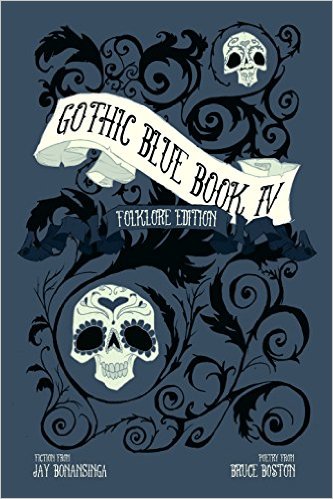
I feel like all writers must dread this question! It’s so hard to choose; they’re each like a little piece of me, and they have their strengths and weaknesses. Currently, though, I think my favorite is “Making Friends,” which is in Gothic Blue Book IV from Burial Day Books. It’s just this creepy story about loneliness, and I really love how it turned out.

Big thanks to Nicole for being part of my author interview series! Find her at her blog where you can learn more about the 341 project as well as her upcoming publications!

Happy reading!

Finding Humor in the Horrific: Interview with Larry Hinkle

For this week’s author interview, I’m pleased to present Larry Hinkle. Larry is a talented speculative fiction writer hailing from Colorado. Like many of the writers previously featured on this blog, Larry and I met through Sanitarium Magazine where we’re both slushpile readers. Below, we discuss the perils of works in progress and how the editing process never really ends.

A few icebreakers to start: when did you first decide to become a writer, and who are some of your favorite authors?

Larry HinkleI’ve only been writing fiction for a couple years, but I’ve been writing ads (I’m a copywriter by trade) for over 20 years now.

I wanted to be a writer when I was younger, and took a couple classes in college, but the feedback was so soul-crushing it convinced me I wasn’t good enough, which is how I ended up in advertising. Now, instead of writing stories that scare people into peeing their pants, I write ads that scare people into buying adult diapers lest they be caught peeing their pants.

Reading On Writing by Stephen King gave me the courage to try writing stories again. I’m never going to make a living at it, but it helps me avoid more dangerous vices like exercise or meditation.

My favorite author is early Stephen King (he’s still a great writer, just not that scary anymore). His son, Joe Hill, has a great collection of short stories, and his last book N0S4A2, reminded me of his dad’s early work. David Wellington is really good. David Wong (editor of Cracked.com) has a couple books that are hilariously scary fun. Same with Jeff Strand.

Tell me a little about your writing process. When do you find time, do you edit as you go, and how long do you typically spend on revisions?

I do most of my writing late at night, after my wife’s gone to bed and before the Lunesta kicks in. Sometimes when I get stuck on writing an ad during the workday, I’ll write a piece of flash or work on a chapter just to get my mind off advertising.

I’m constantly editing. (In fact, I’ve edited these answers at least nine times now.) I’ll give stories to friends to read for me, and by the time they send it back, I’ve already rewritten it another two or three times. Personally, I don’t think a story is ever finished; you just find a point where you’re happy enough with it to let it go. But when it comes back with a rejection slip, that’s also another chance to tighten it up and make it better.

Your published fiction belongs primarily to the speculative genre. Do you plan to branch out into other genres, or is speculative what you prefer to write?

Horror is definitely my favorite genre, although everything I write seems to have a little bit of humor thrown in. So I guess horror-humor is my favorite genre. Unfortunately, there aren’t a lot of outlets looking to publish such an unholy hybrid.

I used to be a staff writer for a couple of big entertainment websites doing recaps back when recaps were cool, and I mixed in humor and horror and literary/pop culture references whenever I could. I once did a recap of a Mad Men episode mashed up with Night of the Living Dead. Another favorite was WWE Raw mashed with West Side Story, which, now that I think about it, is a pretty frightening concept.

My Favorite ApocalypseOut of your published pieces, do you have a personal favorite?

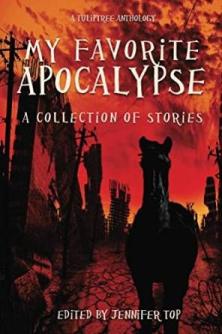
Probably “The Quantum Dead,” which used quantum physics as a backdrop to explain the zombie apocalypse. It was a good mix of horror and humor, with a nice twist at the end, which are great when they work, but not always required. (I’m looking at you, M. Night Shyamalan.)

My friends would probably pick “The Outpost,” which unfortunately has yet to find a home, so you’ll have to take their word for it. Or my word for it, I guess, since I’m the one saying it’s their favorite.

What projects are you currently working on?

Too many. I’m much better at starting stories than I am ending them. A few of the ones right now that don’t totally suck include stories about a guy who wakes up in a different version of himself every day; a company that helps customers prelive a memory (instead of reliving it); a GPS app that’s also a dimensional portal; a guy who uses his blind spot to make things disappear from reality; and a murderous garden gnome. Will any of them survive to see the light of day? Probably not.

Any links you’d like to share? Thank you to Larry Hinkle for being part of this week’s author interview series! Be sure to check out his stories in publications in My Favorite Apocalypse and in Another Dimension Magazine!

Happy reading!

Film Fanatic: Interview with Austin Muratori

For this week’s author interview, I am pleased to spotlight the work of Austin Muratori. Like so many great authors who have previously appeared on this blog, Austin and I met through the Sanitarium Magazine forum. His varied interests as a burgeoning filmmaker and a genre author set him apart in both fields. Below we discuss the overlap between filmmaking and fiction writing as well as how well-written dialogue makes all the difference in both artistic mediums.

A few icebreakers to start: when did you first decide to become a writer, and who are some of your favorite authors?

Austin MuratoriMy love for writing came at an early age–as soon as I learned how to write, I was hooked. I would write these little stories for my family and then gather everyone I could find, so I could read and perform those stories. I talked a lot as a child, so even before I could write, I would ramble on and on to my family, making up crazy stories.

Then, as I got older and into middle school, I competed in the ‘Young Authors’ contest my school held every year. I actually won three years in a row! That really motivated me to want to become a writer. In high school, I had a creative writing class and learned about the different forms of writing, which really excited me! That was when I found poetry and all the various styles and formats. I also learned actual story structure and that was when things really started to click for me. My teacher played a big part in me wanting to continue my journey of becoming a writer. She pulled me aside one day, and told me that she really appreciates my work, that I have a lot of talent, and that I should certainly continue to pursue my dreams because big things were in store for me.

When it comes to my favorite authors, I would never be able to list them all because I have so many favorites and that list keeps growing and growing. With that being said, some of the authors that have impacted me in a major way are Edgar Allan Poe, Stephen King, William Shakespeare, Ernest Hemingway, William Faulkner, Truman Capote, Oscar Wilde, Mark Twain, Jack Kerouac, Blake Crouch and Dean Koontz.

How does your work as a filmmaker and as a prose writer overlap? Are there any ways the two are at odds with each other?

Filmmaking starts with a script. In fact, the script is the most important part of the filmmaking process because it is the blueprint for the story you are planning to tell, and without that, you really don’t have anything. Essentially, writing is the most important part to the filmmaking process, just as writing is the most important part of prose writing.

With prose, you have more freedom to explore and develop your world and characters; however, you have to be extremely descriptive in order to create a visual image for the reader to imagine, whereas in filmmaking, you have to show what is happening rather than tell. The screenplay has to be simple and visual; you have to show what your character is doing as opposed to describing it. Filmmaking is a very powerful storytelling medium; you get to create amazing visuals, and that allows the audience to share an experience together. Though prose writing is a powerful medium as well, the difference is that in prose writing, everyone will have a different experience while reading a story because they are forced to use their imaginations and everyone’s imaginations are different.

In film, the audience collectively can see exactly the same thing on screen. The cool thing is that like prose writing, people will get something from the story, and that message means something different to each and every person who sees the film. One other interesting thing is that filmmaking is a process. The script is written and rewritten and [the] film that is written is going to be completely different once production starts and everything is filmed. Then it changes one more time as it is edited. So throughout each different process, the story constantly evolves. In prose, the story evolves through one process, and that is rewriting.

My work as a filmmaker and as a prose writer goes hand in hand. I love the challenges both fields present. I think being a versatile artist is very rewarding! Plus it is really fun! For me, the stories will dictate whether they are best suited as a film or if they are best suited as a short story, novel or poem.

If forced to choose, which part of the writing process is your favorite: developing character, crafting dialogue, or establishing setting?

Sanitarium MagazineI would say that my favorite part of the writing process would have to be crafting dialogue. I love being able to make a character come to life through dialogue. To be honest, I take pride in making sure my dialogue is realistic and unique to each and every character. Personally, I feel that without good dialogue, it is almost impossible for a reader to not only get into the story but also to relate to the character overall. I also really like developing characters! I find it fun to be able to live vicariously through a character and not only live a life that is completely different from my own but also to do things that I would never do in real life. It is very exhilarating.

Out of your published pieces so far, do you have a personal favorite?

So far, my absolute favorite is a poem called “The City Within,” which was featured in Sanitarium issue 26. The reason it is my favorite is because while I was working on it, I managed to tap into a flow state that I never had experienced before. Words came easily, and so did the overall emotion of the piece. It has been compared to the works of Edgar Allan Poe, which is really humbling. Also, it was the first piece that I had published, and in fact, it was my first time even submitting anything anywhere. Being a perfectionist, I struggled with being confident enough to submit because I felt like even after a bunch of rewrites that it still wasn’t ready. For this piece, I worked up the courage and made the decision to try and I sure am glad I did!

In what directions would you like to take your work in the future?

I would like to explore more genres and other forms of writing in the future. I have so many short stories, poems and novels that I would like to get published at some point. I also have a lot of screenplays that I would like to get made. Overall I just want to be able to continue to get better as a filmmaker and prose writer and do what I love for the rest of my life. I recently became a faculty member for Sanitarium Magazine and I love it! I really enjoy editing! I hope to do more of it in the future.

Thanks to Austin for being part of my author interview series. Find him online at Twitter, Facebook, YouTube, and his main site.

Happy reading!

Madness Intervention: Interview with Casey Chaplin

Welcome back to the last post of August! That means farewell, summer, and hello, autumn! But before we get to the Halloween celebrations, let’s delve into this week’s author interview. Today, I am pleased to introduce Casey Chaplin. He’s the author of Lizzy, a terrifying story of one unusual girl’s descent into madness. But don’t let the serious material fool you. Casey isn’t above cracking a joke, especially mid-interview. Here, we discuss writing and all the psychological trappings that go with creating true horror.

A few icebreakers to start: when did you first decide to become a writer, and who are some of your favorite authors?

Well, I think I’ve always had an interest in writing. I remember the first story I wrote back in the 3rd or 4th grade – Mumbles the Monkey. I’m still shocked that it hasn’t been adapted for screen, directed by Ben Affleck, and won an Oscar. So sad. Sorry, got a bit off topic. Anyway, I think I’ve always wanted to write, and be a writer. Favorite authors though? Oof, that’s a good one. I’m a fan of Douglas Adams, Christopher Moore, Clive Barker, Dean Koontz. I know, a weird mixture of comedy and horror… You could say it’s a comedy of horrors…no? No, that played out a lot better in my head.

Your novel, Lizzy, deals with the mental instability of the titular protagonist. How did you prepare to write such an in-depth psychological exploration?

Generally I’m a pretty laid back guy and will be the first to crack a joke, or be the least serious guy in the room, but when it came to Lizzy, I did have to make some mental preparation, and if truth be told, I really had to change my demeanor. I went to a dark, dark place, which, honestly, affected my job and life at the time. I watched and read a lot of dark literature and film – American Psycho to name one. I also used a bit of method acting, getting into character, so-to-speak, hence why it hit some parts of my life. I thought about how Lizzy would act, or react to a certain situation, and would play it out that way in real life… Minus the whole killing thing.

Lizzy a NovelSome people believe that when it comes to horror, “everything has been done.” How would you respond to such criticism?

Sadly, I would agree to a degree with those naysayers. There’s still some innovation in the field, but it’s hard to be original when the masses don’t necessarily want original, or the big productions of movies, or even A-list books need to make millions in order to succeed. Taking a risk is almost too much for a lot of people who want to be successful. I think a lot of the best and new ideas come from the little guy, the ones that publisher and firms are too afraid to pick up. The indie genre, or field, or whatever the kids call it now-a-days is the best place to see new and fresh thoughts. I’m sure I’m not the first to tell you that either.

If forced to choose, which part of the writing process is your favorite: developing point of view/voice, crafting dialogue, or establishing mood?

Tough question, truly. I kind of like to do all of the above. I find that developing that voice, the character’s personality is fun as Hell. You can really get inside somebody else and create what feels like a new being. But generating the interaction with other characters and having the outcomes be a surprise to even me is exhilarating. On the other…other hand, the mood and atmosphere is so important to storytelling. I find this to be the most subtle part of the process, which requires a certain craft to nail down. I honestly don’t think that I could pick a favorite, as you need all of those aspects to create something awesome. That, and if you think about it, they all tie into one another – they’re all equally important.

In what directions would you like to take your writing career? Another novel? Shorter fiction? Perhaps a combination of the two?

I’ve got a few other stories on the go. I tend to write in spurts, so some have been sitting on my hard drive for years, others a few months. But as of right now, they’re all novel length, or will be. I’d like to write shorts, maybe an anthology one day. As well, I also really enjoy script writing and poetry. It’s hard to say where I want to go with it all. However, I know I’d like to try my hand at something different than horror coming up. Maybe comedy. Who knows.

Thanks to Casey Chaplin for being part of this week’s author spotlight. Be sure to check out Lizzy’s website at lizzyanovel.com!

Happy reading!


Sparrow Incarnate: Interview with Julia Benally

Another week, another interview with a fantastic up-and-coming writer! Julia Benally is an author of cool and unusual speculative fiction. Her work has been featured in Sanitarium Magazine and Snapping Twig Magazine. And since I’m the editor, I can also reveal she has a story in the forthcoming fall anthology, A Shadow of Autumn. Below, Julia shares her refreshing perspective on the topic of writing.

A few icebreakers to start: when did you first decide to become a writer, and who are some of your favorite authors?

Julia BenallyI decided to become a writer when I was eight years old. My teacher said that we were going to make books in class and suddenly I saw a gold leaf, leather bound volume of exquisite work. Of course, that day I got sick, so I couldn’t go and I missed it. My mom said we would make a book of our own so I wasn’t so sad. I really wanted to see the books my classmates made, but then they were just wads of paper folded into gray blue construction paper and I was so turned off. Ever since I’ve dreamed of that leather bound book and my fingers itched to write. Some of my favorite authors are C.S. Lewis, Jane Austen, Bram Stoker, Michael Crichton, Timothy Zahn and Harold Bell Wright.

You often write in the horror genre. What inspires you to create darker fiction, and what advice do you have for other aspiring horror writers out there?

What inspires me is the reservation. It’s a place full of superstitions and ghosts. Many times what I write doesn’t come from ghosts, but people. They can be monsters too. For the aspiring horror writer, I’d suggest to leave out the raunchy sex scenes and the blood and guts. That isn’t horror, it’s just gross and depraved. Personally I think the perfect horror is Bram Stoker’s novel Dracula. It’s just creepy, especially when  it comes to the Captain’s log, a scene foolishly taken out in all the movies.

If forced to choose, which is your favorite part of the writing process: brainstorming story ideas, writing the first draft, or polishing a piece before submitting it to an editor?

That’s a hard question for me. I can say though that my least favorite is the first draft. It’s shabby, it’s all over the place, it’s downright ugly. So I suppose polishing it would be my favorite part. That’s when I can make it beautiful and play with the words, I can add and drop things, I can find holes, I can tighten it up. For me, it’s in the polishing that the characters come to life.

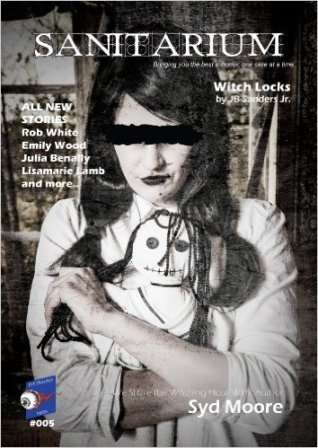
Sanitarium Magazine Issue 5Out of your published pieces, do you have a personal favorite?

My favorite would probably be my very first one because the first is always special. It’s call “The Bridges” and came out in the Sanitarium Magazine issue 5.

In what directions would you like to take your writing career? Are there more short stories in your future or possibly a novel?

Oh, I want to write for life. I can’t do without it. I have several short stories I’m going over, I have several more out finding a home and I’ve recently had one accepted. Not all of them are in the horror genre–for one thing I can’t stay scared all the time, that’s not healthy. I’ve just finished my first novel, a dark fantasy called Pariahs. That one is searching for a home now and it’s part of a series I’ve had in my head since I was 12.

Big thanks to Julia Benally for being part of this week’s author series. Be sure to check out her site, The Sparrow’s Nest. You can also find her on Facebook and Google-Plus.

Happy reading!

Promising Newcomer: Interview with Author Rayne Kaa Hedberg

For this week’s author interview, I’m pleased to introduce Swedish speculative fiction author Rayne Kaa Hedberg. Though just beginning, Rayne’s career is off to an auspicious start with a horror story in Sanitarium Magazine, one of my personal favorite publications out there. Below, Rayne and I talk secrets of the writing process and what’s in store for this up-and-comer.

A few icebreakers to start: when did you first decide to become a writer, and who are some of your favorite authors?

Rayne Kaa Hedberg That’s a tough one. I’m not sure exactly when I decided upon having it as a goal, but I know I have always wanted to write in some shape or form. Already as a small child I composed stories, though up until seventh grade I primarily used it for creating stories I would use in my manga. Somewhere around that time there was a break and I became more inclined to writing only. I left the drawings and began to paint with words to compensate for the lack of visual images. Some of my favourite authors naturally include Stephen King, but also Joe Hill, Clive Barker and Neil Gaiman. They all have a way of showing instead of telling, and I enjoy reading their work.

Your short story, “Donor,” appeared last year in Sanitarium Magazine. Can you share a little bit about your process when writing that piece?

Right, so initially I wanted to submit another piece I had written, but as I didn’t become satisfied with it, I had to start over with a completely different idea. I wanted to have a story about a medical error where you left a great deal unsaid. I did my research, as it’s always a big part of the process, and found out some horrifying things about rules regarding organ donors. “Donor” was originally meant to be my finishing project for writing class. I decided it was worth a try to send it in to Sanitarium Magazine as I had been following their process since the very first issue. I thought I could try my luck since the story was the right genre. Later on I could tell my teacher my story got published, which was a pleasant surprise.

Is horror your favorite genre to write, or are you looking to expand into other genres as well?

I don’t think I have a favourite genre to write in. When I write it doesn’t start in that end. I don’t think about writing a horror story and move on from there. A spark of an idea lights up and as I begin to explore it then I see what type of genre it fits into. I do often write about some type of supernatural element present, however. Often I see how I do end up in horror, but I enjoy working in the various genres as long as it’s an interesting idea. I don’t want to get niched on the one genre. I simply wish to tell the stories.

What monsters or general tropes do you feel are most overused in horror?

Sanitarium Magazine Issue 20I would say the hype on zombies is rather big at this time. I don’t necessarily mind that since many of the writers manage to pull it off well, but at times I lose interest when there’s no element of surprise left. With that said, I am an avid fan of “The Walking Dead”, for example, but when it’s the same old thing with the virus, the survival, the struggle without a twist to it, the stories tend to get predicable. One of my pet peeves in horror has to be the vampire struggling with not wanting to be a vampire and refusing to drink human blood. Vampires now aren’t what they used to be. Although I’m glad they don’t all look like Count Dracula, I wish it wouldn’t be romanticised the way it often is now, in different aspects of the word. Their horrifying factor has been diminished over the years.

What projects are you currently working on?

I am working on a surrealistic novella written in Swedish, for once. After that is finished, I have to go through the pile of unfinished novels and try to see some of them through, but I try to stay focused by taking it one at a time.

Big thanks to Rayne Kaa Hedberg for being part of this week’s author spotlight. Be on the lookout for new fiction from this budding author!

Happy reading!

Versatile Virtuoso: Interview with Bill Soldan

For this week’s author spotlight, I’m pleased to present jack-of-all-trades author Bill Soldan. Like several of my previous interviewees, I met Bill through Sanitarium Magazine where we both toil away as slush pile readers. During the course of our interview, Bill shared his thoughts on everything from balancing work and family to what it’s like to hang out at Emily Dickinson’s house. Good stuff all around for both aspiring and working writers!

A few icebreakers to start: when did you first decide to become a writer, and who are some of your favorite authors?

Bill SoldanWell, I’d like to say I sprang from the womb with writerly ambitions, but I first fell in love with the idea around age 12. I stress the word “idea” because, although I was a ravenous reader my whole life, I never really tried to write anything of my own. When I was about 12, I was reading Stephen King’s The Shining and discovered my mom’s electric typewriter at about the same time. The result was about a paragraph of something called “The Deadman’s Shortcut” or something equally ridiculous. I had no idea what I was doing, but King’s novel was the first book to make me cling to the idea of writing stories.

But I was more into visual art as a teenager and didn’t really write fiction after that sad first attempt. There was a period, however, during which I thought I was Jim Morrison reincarnated. I had the role down, too: the attitude, the hair, the reckless abandon, the concho belt—pretty much everything but the leather pants and the talent. But then, I was only like 14 and a total idiot. Nevertheless, that was the beginning of writing poetry and songs for me. I did that for many years, still not knowing what the hell I was doing, and eventually I took a fiction class, because deep down that was still something I had an inkling to do. For the last, say, four years, fiction has been my primary focus. I’m still figuring things out, though.

As for favorite writers, I can never answer this question without listing the following authors: Donald Ray Pollock, Richard Lange, Daniel Woodrell, Benjamin Percy, Bonnie Jo Campbell, Flannery O’Connor, Jim Carroll, Sherman Alexie, Stephen King, Clive Barker, and many other seemingly dissimilar writers. Quite recently, I’ve just discovered the work of people like Craig Clevenger, Brian Evenson, Mitchell S. Jackson, and Denis Johnson (people seem to be shocked and appalled that I haven’t read his work before—and after reading some, so am I). Those are some of the big ones for me right now.

You’re currently working on your MFA while simultaneously teaching undergraduates. How has teaching affected your own approach to writing?

I can’t say that it has. Not yet anyway. I have recognized that I need to practice what I preach a bit more when it comes to certain things: trusting the revision process, reading my work aloud to find the hiccups in syntax, etc.—but this really applies more to my own academic writing. When writing multiple critical papers at any given time, sometimes it’s all you can do to get them written, never mind toiling over multiple drafts. When it comes to my writing, however, especially my fiction, I don’t have this problem so much. I’ll toil as long as it takes, and then some.

In terms of how teaching and being a student (and a husband and a father, among other things) has affected my writing routine, well, it can be draining, downright exhausting wearing so many hats. With my writing, it’s become a matter of fit it in when I can. But then, I never had a solid routine to begin with. I’ve tried, but I haven’t found what works best for me in terms of a schedule. I invariably do something writing related every day. Often it amounts to little more than brainstorming or jotting down potential first lines, but some days that’s enough to make me feel accomplished. Some days…

You recently returned from the Juniper Summer Writing Institute in Amherst, Massachusetts. What was the most unexpected or surprising thing you learned during the writing intensive?

I learned a lot while at Juniper and met some terrific people. The workshop I was in was revision based, so I didn’t generate much new material while I was there, but I came away with the beginnings of a few new things, several more pages of a work-in-progress, and some excellent feedback on some of my stories. I was so inspired by the atmosphere and sense of community that I had trouble readjusting to life for a couple days after I got home. The passion and talent there was nothing short of invigorating.

Without outlining specifics, I can say that what I got most from the instructional programming were the tips and insights I received from Brian Evenson and Mitchell S. Jackson.

I had the privilege to work with Brian all week, and frankly everything that came out of that man’s mouth was brilliant. He helped me see some areas in my own writing that worked well and some areas that could be better. He also held a craft session that focused on the distinction between people and characters—it was great.

Mitchell likewise helped me identify some things in my own writing. I had a manuscript consultation with him, during which he went through two of my stories with me line by line, showing me areas where the narrative was strong and areas where I should capitalize more on my strengths, which he said are “the acoustics of the sentence,” “dialogue,” and “description of setting, especially natural setting.” These comments were very motivating and encouraging, as these are three elements of prose that are particularly important to me. He also held a craft session that focused on “the poetry of prose,” which was an absolute goldmine.

What was most surprising, though, was the community of writers. I probably got more from spending time with all these awesome people, from our trips into town, our nightly readings, than from anything else. It was a time I’ll never forget, and I can’t wait to cross paths with some of them in the future.

While in Massachusetts, you posted pictures from Emily Dickinson’s house. In my past travels, I’ve always searched for any opportunities to visit the workrooms of famous authors. What kind, if any, inspiration do you find from visiting the home of famous writers, and how does it inform your work?

Visiting Emily Dickinson’s home was the first time I’d ever done anything like that. The most inspiring part of the tour was seeing her bedroom, which they’re in the process of restoring to its original state. Seeing her tiny writing desk and looking out the same windows she gazed through while penning many of her poems was surreal. (I still want to visit Robinson Jeffers’ home in Carmel, CA. That’s supposed to be one hell of a sight.)

Being there only informed my work insofar as it reinforced something I’ve always believed: that great art can spring from anywhere— if only we pay attention.

In what directions would you like to take your writing (e.g. more short stories, novels, nonfiction)?

I want to do it all. Poetry, nonfiction, novels, story collections—you name it. Right now I’m focused on getting some more of these short stories out of my head and working on my thesis, a (tentative) collection of linked pieces. I do want to tackle a novel at some point, but I haven’t taken that plunge just yet. I’ve got an idea brewing, but I’m keeping myself busy with several other shorter projects for the time being.

I have the urge to write creative nonfiction, but whenever I think of an experience I want to write about, I end up turning it into fiction instead. I’ve come to realize people will believe a lot more of your insane life history when you present it as fiction. Much of my fiction has autobiographical moments, sometimes entire scenes wrenched more or less from memory (a lot more than many people would be willing to swallow if I presented it to them in an essay or memoir) but I’ll leave it to readers to decide which of those are fabricated and which are not.

 Out of your published pieces so far, do you have a personal favorite?
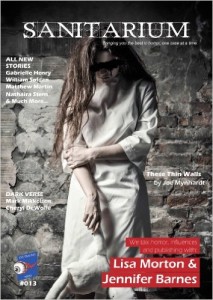
Sanitarium MagazineThough it’s far from my best work, I’m still in love with my story “Patchwork,” which appeared in Sanitarium magazine issue 13. It was the first story I ever completed in my first fiction class as an undergraduate, so there’s some significance there. The story has a lot of flaws, the least of which not being that it’s virtually all surface, meaning there’s little to no emotional undercurrent. I have a tendency to write fairly “detached” first-person narrators, but since doing this for a few more years, I’m learning the importance of emotional weight and resonance, even in characters that at first seem cold and indifferent. It’s something I think I’m getting better at, slowly but surely.

The story I consider to be my best, in terms of published pieces, is one called “Something Special,” which appeared in the Winter 2015 issue of Floyd County Moonshine. Not only do I feel this piece contains an emotional undercurrent while maintaining a relatively hard-edged surface, but it’s much more representative of the type of work I’ve been producing for the last couple years. Most of what I’ve published, with the exception of maybe two pieces, is quite different from (and in many ways not nearly as good as) what I’m writing now. Which is why I’m often reluctant to link people to my earlier work—I’m just not as happy with it as I once was. Nevertheless…

Any links you’d like to share?

If you’d like to read something for free, here’s a link to the only creative nonfiction piece I ever published. It’s a decent blend of the kind of prose I’m writing now and the more “speculative” stuff I haven’t written for a while. A bit of a mashup of fiction and nonfiction. There’s a lot about it that I like and some minor things I don’t. For one, there are some typos, which horrifies me, but I’m human, and so are copyeditors, thus it happens. Anyway, you can read it here: http://www.jennymag.org/fall-13-issue/sad-beauty

There are some others out there. Somewhere in the ether.

Big thanks to Bill Soldan for being part of our author series this week! Find him on Facebook, Twitter, and Instagram.

Happy reading! 
Poe Protégé: Interview with Tawny Kipphorn

This week’s author is a major devotee to none other than Edgar Allan Poe, which practically makes us blood sisters to the cause. Tawny Kipphorn is an up-and-coming horror writer who pens both fiction and poetry. With a knack for the beautifully macabre, her work has appeared in Sanitarium Magazine and The Tales from the Shadow Realm among other publications. Recently, I talked with her about her many current and upcoming projects.

A few icebreakers to start: when did you first decide to become a writer, and who are some of your favorite authors?

Tawny KipphornI made the discovery of my passion at fifteen, during english class in my freshman year of high school when we were learning about Edgar Allan Poe. We were reading “Annabel Lee” and something just ignited within me and told me that it was imperative that I do my part to help bring back that literary style, and I’ve since desired to create things with that same sense of beauty. However, I didn’t make the conscious decision to become a writer until my first publication in 2014, which was The Hellequin of Volterrum (Story Version) in the Tales From the Shadow Realm digital magazine. I always had a draw to language and literature since I was in grade school, and even in my teenage years when I was constantly writing and living in my head, I never saw myself becoming an author because I thought my passion would run dry if I were doing it for a living, plus it’s the only area in which I’ve been able to excel. It took me a very long time but I finally accepted that this is what I’m meant to do.  Aside from Edgar Allan Poe, I also enjoy Lord Byron, D.H. Lawrence, Patricia Cornwell, and James Patterson.

You write both prose and poetry. How is your approach the same (or different) for each?

My approach for both is the same in the sense that I really try to do as much research as I can before I begin any project. For poetry, most of the time I try to make them rhyme and go along the same cadence as Poe’s “Annabel Lee”. I describe my poetic style as being Poe meets Seuss. They say you’ll spend the rest of your life trying to recreate the first poem you ever loved, and that holds true for me. I’m a poet at heart and so it comes much more naturally to me than writing fiction, which I find to be much more difficult. When writing poetry, I also like to move words around to give the sentences a more archaic fluidity. Fiction is something I’m working on slowly but surely, it’s a fairly new thing for me. It’s different also because usually with fiction, I have a vision and know where it’s going, but poetry just flows more freely and I won’t know where it goes until the end.

What initially drew you to the horror genre, and is it your favorite genre to write?

SanitariumI grew up reading and collecting The Goosebumps Books by R.L. Stine, and also watching a lot of horror movies. I’ve always been interested in the darker more macabre, supernatural things. I spent most of my time in middle school engrossed in vampire themed books and went through a goth stage as well, so I really embraced the whole image. It is definitely my favorite genre though it can be quite challenging to write. When I have a story in my head, it usually plays along the lines of Quentin Tarantino meets Stephen King. When I envision the possibility of bringing these stories to life it gives me a pleasure that I couldn’t get from writing any other genre, especially as a woman in what most would consider a male dominated genre.

Out of your published pieces, do you have a personal favorite? 

This is a tough one because it’s a toss up, but I would have to say my favorite published piece is “Rosalee”. I wrote it with the intention of creating something as beautiful as (yep, you guessed it) “Annabel Lee”. Much to my surprise after I wrote it  I actually discovered Poe had a sister named “Rosalie” which I thought was amazing. I changed the spelling from “Rosalie” to “Rosalee” as a dedication to my mother.

Any projects you’re currently working on?

Several! My document folder is horrendous. I have a poem in progress entitled “The Legend of Countess Creep” which is about Elizabeth Bathory. I also have a science fiction short story titled “Project Blue Blood” in progress, and my biggest project in the works is “Steven”, which is the life story of a serial killer with an unusual MO.

Thanks to Tawny for being part of this week’s author spotlight! Check out more about her writing at her website

Happy reading!