Category Archives: Interviews

Strange and Funny: Interview with Paul Wartenberg

Welcome back! As a nice change of pace here on my blog, today’s featured interview is between editor Sarah E. Glenn and author Paul Wartenberg. Way back in early 2015, I first launched this author interview series with several of Sarah’s interviews with her authors from Mystery and Horror, LLC. So this is truly a return to form, and a particularly welcome one: Sarah and Paul recently worked together on Strangely Funny III, the sequel to Strangely Funny II which was the first book to feature my fiction. In a way, this blog is very much like coming home!

Now enough about me, and on to the main event! Author Paul Wartenberg has been published in various anthologies, including Strangely Funny, Mardi Gras Murder, and History and Mystery, Oh My! He published his own anthology, Last of the Grapefruit Wars, and has self-published shorts and novellas such as The Hero Cleanup Protocol and Body Armor Blues as ebooks. He’s also a devoted cat owner, which always wins you points on my blog.

Below Sarah and Paul discuss the inspiration for his Strangely Funny III story, “Minette Dances with the Golem of Albany,” as well his upcoming plans as an author.

Sarah Glenn: How did you get the idea for your story in Strangely Funny III?

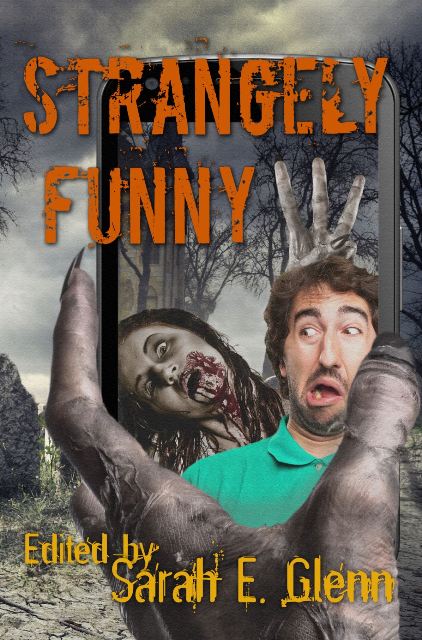
Strangely Funny IIIPaul Wartenberg: I’ve been fascinated with the legend of the Golem of Prague, and had been wondering how I would write a story about it wandering about a modern-age urban city. Would it still be something of a protector of its community? Has its long age given it any insight into the human condition that it otherwise did not know before? Could it have gained a soul?

I then considered what it could be like for Golems to be made elsewhere… and then I remembered my birth-state of Georgia is well-known for its red clay. The idea of a red-skinned (“redneck”) Golem from my hometown became too tempting to ignore. I wanted to have a Golem, and I wanted to use the background from my earlier vampire story to try and expand my “playground” so to speak with other vampire characters.

SG: Who are your current favorite authors? What do you enjoy about them?

PW: I’ve been reading Lee Child for some reason. The Jack Reacher stuff. I’m usually not much of a thriller reader, but there’d been a lot of checkouts of his work at my library so I took a look. It’s sort of like reading Die Hard as written by Hemingway. Otherwise I’ve been keeping up with my regular readership of Tim Dorsey for the bizarre Florida-esque humor and various graphic novels.

A Serious TankSG: What is your favorite writing snack food/drink?

PW: I drink iced tea, lots of. Have to cut back on the sodas. As for food, I snack between writings, I loathe getting crumbs and grease on the keyboards.

SG: What are you working on next?

PW: Struggling with the NaNo novel project from last November, and getting short stories finished for the Florida Writers Association’s annual anthology projects.

Big thanks to Sarah E. Glenn and Paul Wartenberg for stopping by my blog today! Read Paul’s latest ebook, A Serious Tank on a Clockwork World, and be sure to pick up a copy of Strangely Funny III, from Mystery and Horror, LLC!

Happy reading!

Dead and Loving It: Interview with Andrea Janes

Welcome back to another author interview! This week I’m pleased to spotlight Andrea Janes! I first discovered Andrea when I was writing at Wanderlust and Lipstick and I spotlighted her New York-based tour company, Boroughs of the Dead. Since then, she and I have crossed paths again as horror writers, and I figured it was about time to highlight all the great work she’s doing!

Recently, Andrea and I discussed her role in macabre tourism as well as her burgeoning fiction writing career.

A couple icebreakers to start: when did you first decide to become a writer, and who are some of your favorite authors?

I don’t think it was my decision to make! I learned to read when I was three — my big sister taught me — and wanted to be a writer by the time I was six. We grew up total bibliophiles, and I think we just always knew that literature would be a huge part of our lives. My sister’s now a professor of Canadian literature at the University of Toronto. That being said, I haven’t been writing steadily for the past thirty years. I took a few breaks here and there like my half-decade studying and working in film, and the two years I took to start and build my tour company, Boroughs of the Dead. I’ve spent as much time trying to figure out how to make a viable living as I have working on the actual craft of writing.

As a reader, I’m not really a completist so I tend not to think of my favorites in terms of authors but usually more in terms of individual books or stories — except for Poe, M.R. James and Shirley Jackson, whose fiction I think I may have read in their entirety. But some other authors and books I’ve loved, latched onto, and become obsessive about include: W.G. Sebald, Dorothy B. Hughes, Elena Ferrante (the Neapolitan Trilogy), Lawrence Block, and Donald Westlake/Richard Stark (the Parker books); Stoner, The Woman in White, Moby Dick… oh man, this could be a really long list. What all these have in common was that my first encounter with them was revelatory, either for the way these authors wield language — whether stripped down hardboiled genius or overflowing lyrical gorgeousness —  or for their works’ sheer hugeness of theme, story, emotion. (In the case of The Woman in White, the character of Marian Halcombe had a lot to do with it!) And humor, I really appreciate a sense of humor, which is actually what I think I love best about Edgar Allan Poe.

As mentioned in the intro, I first discovered you when I was writing at Wanderlust and Lipstick and spotlighted your macabre tour group, Boroughs of the Dead. How, if at all, has your work in tourism affected your writing, or vice versa?

You know what’s funny? We don’t really get as many tourists as we do locals on our tours! So I never really think of what I do as tourism, which is weird, I guess, because it is, really. Anyway, to answer your question: editing! Pacing! Winnowing down a story to its essence, cutting extraneous details. Nothing like a live audience’s eyes glazing over to tell you when you’ve gone into too much backstory! The instantaneous feedback is invaluable.

You are one of the many amazing authors slated to appear in the forthcoming Shadows at the Door anthology. What can you reveal about your story?

I can reveal that it’s based on one of my more memorable trips to the post office! Actually, there’s a lot of very personal stuff in that story, like observations about my own neighborhood, and the fact that the main character is a film archivist (I do love silent film, and I was watching Guy Maddin’s The Forbidden Room, which is an homage to lost silent films, while I was writing it). There’s a lot of stuff in there where I try to connect the dissolution of a psyche under the strain of living in New York City and the fragments of silent film the protagonist tries to put together. There’s a lot of stuff about the many layers of life and death in this city, the way we all pile on top of each other, inhabiting each other’s old, used spaces — as well as some commentary on how a lot of these layers can go completely unnoticed if you’re not looking for it. Finally, I tried to show how miniature cities exist within New York, subcultures within subcultures, worlds within worlds, and how you can live within them and still be an outsider. The supernatural element to the story is deliberately vague. I wanted the ghost in this story to be both literal and an amorphous entity that isn’t quite nameable — just one of many strange encounters that a person can have in this city where the dead and the living live side by side.

Do you have any rituals as a writer, or any specific tips for how you work through writer’s block and/or creative slumps?

Boroughs of the DeadNot really; I try various things. Right now I’m trying to get as much writing done as I can before I give birth to my first baby, who is due on May 18th. So I’m doing this thing where I set my cell phone timer for twenty minutes and write in these small increments, which helps me get started. Once I get on a roll, hours can pass and I won’t notice — but it takes a lot of warm-up to achieve that semi-liminal state of consciousness where the words start to flow. The 20-minute timer thing helps me relax into it without putting crippling pressure on myself.

But normally I don’t really force myself to work through major bouts of writer’s block. When I have a creative dry spell, I just go and do something else for a while. I’m sure if I was on deadline it’d be different and I’d have to think up a solution right quick, but I don’t have that pressure so I don’t overthink it. As long as I get a certain amount of stuff done within a reasonable amount of time, like one short story a year, I don’t worry too much.

Where would you like to see your writing career in five years?

I’d like to really buckle down and hone my craft a little more than I have so far. A lot of the time I feel like I’m not where I should be yet, technically, as a writer. I’m still in the middle of writing my first novel-length ghost story and it’s been a huge challenge for me. Just the sheer unbroken momentum it takes to finish a novel is such a luxury of time and energy, and it’s so hard not to get sidetracked in this life of many and varied pressures and distractions. I’d like to finish the novel and be proud of it. I’d like to just keep getting stronger and more assured, and read my own work and not cringe. At this point in my life I’m a lot more interested in the work itself than anything else. If the career stuff comes, it comes, and that’s great. If it never comes, but I find at the end of my life that I’ve done right by my inner six-year-old and written something worth reading, I’ll be happy.

Out of your published work, do you have a personal favorite?

I really like “Morbus,” which is in the collection Boroughs of the Dead. It’s a humorous story in which a thief agonizingly dies of cholera in a mansion loosely based on J.P. Morgan’s, and features a sassy demon. And “Newtown Creek” in the same anthology, because it grew out of a childhood nightmare of mine and is kind of close to my heart. I probably worked the hardest on my one and only Weird Western, “The Last Wagon in the Train,” which was published in the Tenth Black Book of Horror and got an honorable mention in one of the Year’s Best Horror anthologies.

Big thanks to Andrea Janes for being part of this week’s author interview series! Find her at her author website as well as at Boroughs of the Dead, the place to go for New York City’s best ghost tours!

Happy reading!

Horror Star: Interview with Tabitha Thompson

Welcome back for this week’s author interview! Today I am thrilled to spotlight the awesome Tabitha Thompson. Tabitha’s horror fiction has been featured in multiple issues of The Sirens Call, and she is currently hard at work on new stories that are sure to be as amazing as her previous work!

Recently, she and I discussed her inspiration as an author as well as her current projects and where she sees the trajectory of her career headed in the coming years.

A couple icebreakers to start: when did you first decide to become a writer, and who are some of your favorite authors?

Tabitha ThompsonAlthough I’ve been writing stories since I was 5 and started horror fiction when I was 16, I never thought of myself becoming a writer honestly until I was published at 23. Even to this day however, I still continue to gain knowledge and find my voice when writing and I have found it to become more than a hobby but a passion. I can honestly say however that I didn’t find writing, it found me, and as of late it hasn’t let me go. Some of my favorite authors are Edgar Allan Poe, Stephen King, Jack Ketchum, Anne Rice, Ray Bradbury, Toni Morrison, Pheare Alexander and Shane McKenzie.

Do you have any rituals as a writer (e.g. writing at the same time of day or at the same place)? Also, do you have any tips for how you work through writer’s block and/or creative slumps?

I have to admit, it’s rare that I have a set ritual, given that I’m pretty flexible when it comes to my writing, but I always start off with coffee, in my book coffee is life. But aside from that, before I start writing, I listen to motivational videos and do yoga, meditation and prayer to get a healthy mind, body and spirit. Now although factors like work take up some time, I try to write at least anywhere from 1,000-1,500 words in the evening. My tips for dealing with writer’s block and creative slumps is I would take a break from writing and listen to music, preferably rock or classical, and read various books to keep the creative juices flowing.

If forced to choose, which is your favorite part of the writing process: crafting dialogue, plotting the story arc, or developing characters?

My favorite part of the writing process is celebrating that I haven’t gone gray or completely insane afterwards. Jokes aside, I love plotting the story and developing characters simply because I become easily inspired by a simple conversation, actions or emotions from other people as well as my own personal experiences.

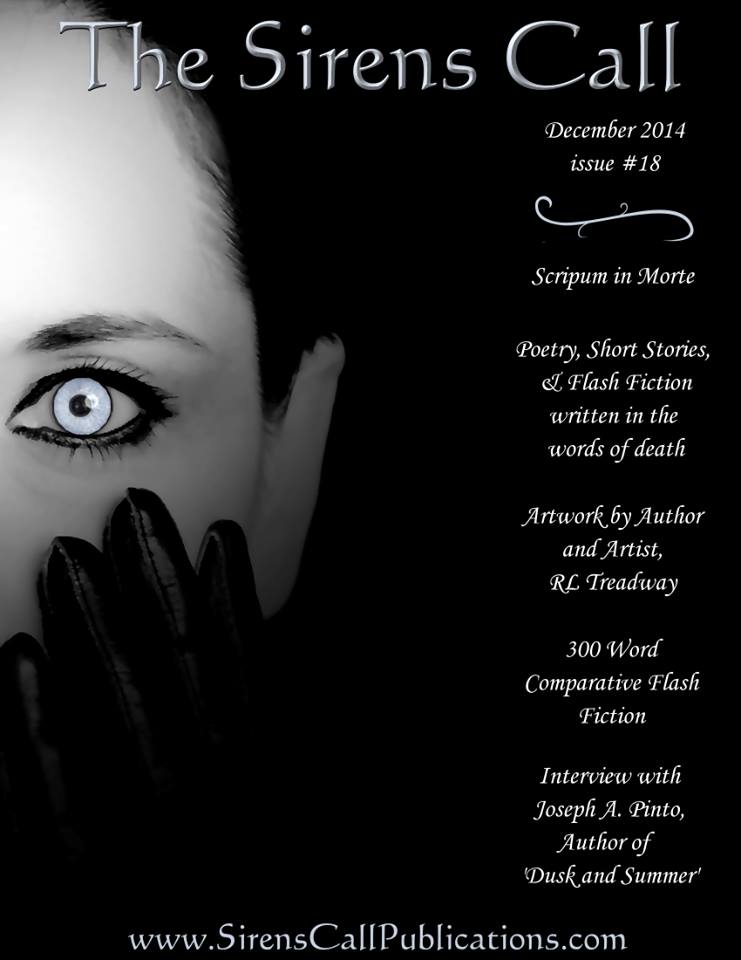
Sirens Call Issue 18What projects are you currently working on?

Even though it has been a while since I’ve released any new stories, for this year, I’m currently working on a few stories titled “Black Sheep”, “Evil, I”, and “Haunted”. I like the direction each of the stories is going and it makes me even more excited to finish them and put them out.

Out of your published stories, do you have a personal favorite?

My favorite published story has to be “West Nile”. It’s my first apocalyptic story where the protagonist is written in the first person and can resonate with readers. Given that I live in Florida, a tropical state that is notorious for mosquitoes in the summer time, the story shows the worst case scenario of a simple mosquito bite. Once I’m done with my other projects, I’m planning to write an extended version of that story.

Where would you like to see your writing career in five years?

In five years, my goal is to be able to write full time, have a #1 bestseller, and to make an impact in horror fiction. As ambitious as it may seem as a black female writing horror fiction, which is considered a rarity, I would love nothing more than to not only change the game but to inspire and motivate other girls to take a risk and follow their own creative path with no regrets whatsoever. Plus I would love to prove that not all of us black females write literature that involves the hardcore streets, but we can also write some hardcore horror.

Huge thanks to Tabitha Thompson for being part of this week’s author interview series! Find her online at her author site as well as on Facebook and Twitter!

Happy reading!

Fairy Tale Favorite: Interview with Shannon Connor Winward

Welcome back! For this week’s author interview, I’d like to introduce Shannon Connor Winward. Shannon is a widely published author of poems and prose, with work appearing in such publications as Strange Horizons, The Pedestal Magazine, and Flash Fiction Online, among other venues.

Recently, Shannon and I discussed fairy tales, writing rituals, and her upcoming plans as an author.

A couple icebreakers to start: when did you first decide to become a writer, and who are some of your favorite authors?

I was a very creative, weird, dramatic kid.  I’ve always had an overactive imagination and a passion for the macabre.  I started to focus on poetry and stories when I was about eight; by ten I’d decided to be the next Stephen King.

King will always have a special place in my heart (The Stand changed my world).  I also love Gregory Maguire, Neil Gaiman (esp. Anasi Boys), Juliet Marillier, George R. R. Martin, Diana Gabaldon, Anne Lamott, The Mists of Avalon by Marion Zimmer Bradley, The Time Traveler’s Wife by Audrey Niffenegger, The Lovely Bones by Alice Sebold, Kissing the Witch by Emma Donoghue.  I don’t get to read novels as much as I used to because I have a toddler and an Aspie vying for my attention, but I’ve started Jonathan Strange and Mr. Norrell by Susanna Clarke, and it’s wonderful.

I am a big fan of your poem, “Snow Waiting,” that appeared last year in Gingerbread House Lit. What was the inspiration for this piece, and do you expect to do any more fairy tale retellings in your future work?

Thanks! Actually I wrote “Snow Waiting” for a magazine I like that was holding a fairy-tale themed-contest.  I don’t know what made me think of Snow as a foster kid, but I like twisting our expectations of fairy tales, gender roles.  Snow White is exploitative.  It’s all about Snow’s looks, what people want from her.  She’s just a pretty victim.  My Snow is also tragic, but I tried to give her a little edge.  She’s probably going to get her heart ripped out, but I like to think she’ll survive.

Obviously “Snow Waiting” didn’t get picked for the contest, and I shopped her around for a while before finding a home with Gingerbread House.  Sometimes that happens, a piece gets rejected until finally someone says “YES WE LOVE IT” and it turns out to be the perfect match.  I was really happy with the reception “Snow” received there.  The artwork they chose for her is just stunning.

I went through a spell where I wrote quite a few fairy tale revisions (I was in love with a librarian who was in love with fairy tales).  My poems “Bride Gift” and “Fallen” are other examples. It’s not my primary focus but, yes, I expect I’ll write more. It’s a really fun genre to explore.  A lot of my work is also myth- and folklore-inspired.

Is there a certain genre that’s your favorite?

My tastes are pretty eclectic. I like stories laced with fantasy (high or low), magical realism, genre-bending, interstitial stuff.  Mythpunk.  Character-driven sci-fi. I like creepy and weird but not (necessarily) grit and gore.  Or not *just* grit and gore. I don’t love genre for its own sake.  I’m interested in the psychology of characters, the human condition, stories with heart.  I like books that leave you weeping at the end, like you’ve just found (or remembered?) another piece to the puzzle of life, the universe, and everything.  I prefer stories that make you better for having read them.  That’s the kind of story I hope to write, too.

Do you have any specific writing rituals? And is your approach different depending on whether you’re crafting prose or poetry?

I need lots and lots of head space to write.  I need my kids to be quiet (preferably sleeping or out of the house) and nobody can talk to me.  I need a cup of coffee or a cigarette (if I’m smoking that year), something to channel the energy through my hands, because otherwise my thoughts tend to get log jammed.  I find lighting a candle helps, too.

The only difference in the process of writing poetry or prose is that poetry is faster.  I can work on a poem or two before I get interrupted and have to change a diaper or make a phone call.  Fiction requires that I maintain the mindset much longer; if I stop, I have to work very hard to find my way back in. So it can take me years, decades even, to be done with a short story, unless I enter a sort of manic state where I ignore everything and everyone until the project is done.  Which happens.  Thankfully, I have a very supportive (and long-suffering) spouse.

Out of your published pieces, do you have a personal favorite?
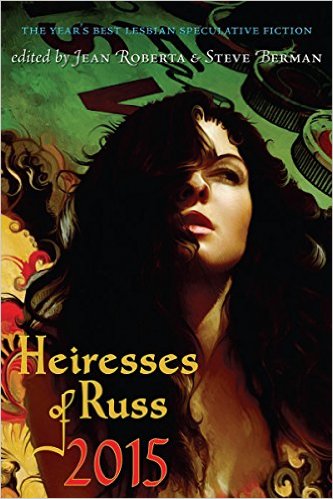
Heiresses of RussMy poem “Session,” which appeared in The Pedestal Magazine, is a definite favorite.  It was my first professional poetry sale, and it’s sort of a signature piece about the anthropology of the psyche.  It’s very representative of how I write and what interests me.

For fiction: “Babycake”, which just came out in Gargoyle Magazine, was super fun to write.  It foreshadowed the birth of my daughter, as I was pregnant when I wrote it and didn’t know it.  My science fiction story, “Ghost-Writer”, was inspired by a book by scientist Jill Bolte Taylor, who suffered a debilitating stroke to her left brain hemisphere.  That story has a lot of my heart in it.  It was anthologized in Heiresses of Russ : The Year’s Best Lesbian Speculative Fiction 2015 (Lethe Press), which was a real honor. I’m also looking forward to “She Is”, my quirky take on the Orpheus and Eurydice myth, with the gods playing a table-top RPG in Hades’ basement.  That’s coming out soon in Stupefying Stories.

Where would you ideally like to see your writing career in five years?

Well the last few years will be hard to beat.  I’d really like to see my novel published.  I’m still waiting to make that love match with the right press, but I think once I do and I’m able to hold that book in my hands, it will be a very meaningful milestone.

I’m also working on a book-length collection of poetry and prose, a memoir about living with mood disorder and raising a child with mood disorder and autism. I hope to have that completed and published in five years and be travelling with it, reaching out to other families, advocating. The landscape for our kids can be pretty bleak.

I’d like to commit to a second novel (I’ve got several in the running but I keep getting distracted).  In general, I hope that in five years I’m still writing and making money and making a difference in my communities.

Big thanks to Shannon Connor Winward for being part of this week’s author interview series! Find her online at her website!

Happy reading!
Shockingly Good: Interview with John Boden

For this week’s author interview, I’m pleased to spotlight John Boden. John is a dark fiction writer of many short stories, and he’s also a contributing editor at Shock Totem. His work has appeared in LampLight, Robbed of Sleep, and Once Upon an Apocalypse: 23 Twisted Fairy Tales, among others.

Recently, John and I discussed his favorite authors (Bradbury!), his tenure at Shock Totem, as well as writing fiction based in our shared home state of Pennsylvania.

A couple icebreakers to start: when did you first decide to become a writer, and who are some of your favorite authors?

John BodenI have always wanted to be a writer, since first reading Ray Bradbury in school. Then I moved on to Stephen King. I actually sent him a story I wrote when I was maybe eleven. It was about a vampire Vacuum cleaner. I got a standardized postcard back with a little handwritten note on it that I always assumed/hope was from him. I wrote all through high school and what little college I made it through.  I pretty much gave it up for twenty years and only really went back to it when we started Shock Totem. Some of my favorite authors would/could on a given day be:  Agatha Christie, Louis L’Amour, Stephen King, Ray Bradbury, Charles Beaumont, William S. Burroughs, Shirley Jackson, Willa Cather, Harlan Ellison, Gahan Wilson, John Skipp, Robert R. McCammon, Robert Aickman, Stephen Graham Jones, Margaret St. Clair, Rod Serling, Jack Ketchum, James Newman, I could go on for days.

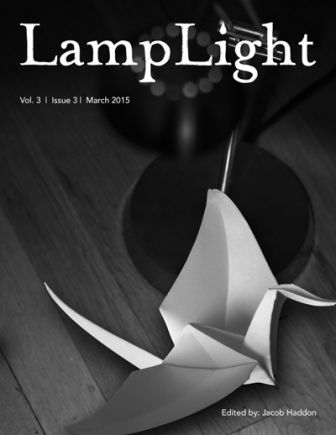
The first story of yours that I read was “Possessed by a Broken Window,” featured in LampLight, Volume 3, Issue 3. Without giving too much away, this multi-layered tale deals with grief, illness, and the oppressive atmospheres of hospitals. Although we’d never choose it, most of us can relate to these themes. What inspired this story, and were there any particular challenges you experienced during the writing process?

I wish I could tell you some glorious anecdote here but I can’t.  That story is one hundred percent true, every action in it and person is real and happened. I added a slight bit of the fantastical to make it fiction.  It was one of the hardest stories I ever wrote. It was part of a long series of very sad things that I wrote after my father passed.

Your book, Dominoes, is fashioned in the manner of a Little Golden Book, albeit with some proverbial hardcore horror. Was there a particular moment or memory about Little Golden Books that made you say, “Yeah, I totally need to twist this up and give people nightmares”? And do you have a personal favorite Little Golden Book? (I for one am obsessed with The Color Kittens and their never-ending acid trips.)

It wasn’t quite that thought out. We just thought it would make an interesting presentation to package it as a children’s book. I’m actually still surprised at how well it’s been received as it is far from a linear story experience. As for my favorite Little Golden Book, probably The Saggy Baggy Elephant.

LampLightIn addition to your fiction writing, you’ve worked as a contributing editor at Shock Totem. How has the behind-the-scenes experience in the publishing world informed your work as an author?

It has opened my eyes quite a bit. I’ve been reading all of my life and never really knew what it took to get those books from the author’s head into my eager hands.  You know how if you’ve ever worked in retail, you’re like the most patient and nicest customer ever…because you understand the hell that is that side of the counter?  Publishing is a very similar situation. It made me look at a lot of aspects that I never thought on before.

Like me, you are a resident of Pennsylvania (hi, neighbor!). Does the gloomy weather, sickeningly bucolic hillsides, and complete lack of easy booze access often inspire your dark fiction?

I’ve lived in Pennsylvania all of my life. I grew up in a tiny town called Orbisonia.  It’s nestled in the mountains between Chambersburg and Huntingdon, if that helps anyone.  It’s beautiful there. Booze never enticed me. I’m sort of allergic to alcohol so I don’t drink. I always find myself setting my work in my hometown, regardless of where I place it…it’s always Orby.

What’s the best writing advice you’ve received? And do you always follow it?

I don’t know that I’ve ever actively asked for advice.  I mean, I’ve sent stories to fellow writers and asked their thoughts. But I know that John Skipp and others have told me in conversation that you need to write honest. I’m sure they’ve said it better. But it really is about that.  I approach a story with the only goal being for it to come out of my head and onto the page with as little mutation as possible.  The mutation usually comes in later.

What upcoming projects can we expect from you?

I start so much and finish so little. Heh. Projects: Michael Wehunt’s Greener Pastures collection is coming soon, I did some editing on that.  It’s fantastic. Personally, I’ve been trying to land a home for my coming-of-age novella, Jedi Summer. I pulled a lot of reading favors from friends on that one and everyone seemed to dig it.  There’s a collaborative thing I did with Mercedes Yardley called Loving The Girl With X’s For Eyes we’re trying to get out there. I have some stories coming out in various anthologies—Borderlands 6, Bumps in The Road and another one I can’t recall the name of right now.  I’m nearly done with the Dominoes-style Haunted House thing and halfway through my novella-mayhaps-novel, Spungunion.  There’s other stuff, too.

Thanks for the opportunity to blather on.  It was an honor sharing a Table Of Contents with you.  [Extends hand for super secret “You-Gotta-Be-From-Pa” handshake]

Big thanks (and secret handshakes!) to John Boden for being part of this week’s author interview series! Find him online at his blog, and be sure to keep up with the great work he’s doing at Shock Totem.

Happy reading!

Ghostly Devotion: Interview with K.B. Goddard

Another week, another great author to spotlight! Today, I’m proud to bring you K.B. Goddard. K.B. is a writer of fantastical fiction. Her focus is primarily on subtle supernatural tales in the vein of M.R. James and other Victorian scribes of ghost stories.

Earlier this month, K.B. and I discussed her evolution and inspiration as a writer, as well as the forthcoming Shadows at the Door anthology, which will feature one of her incredible short tales of the macabre.

A couple icebreakers to start: when did you first decide to become a writer, and who are some of your favorite authors?

KB GoddardI’m not sure when I finally decided. I know it was one of those ideas that floated around in my mind since I was a child. For years I thought I’d like to write something one day. Then I started studying creative writing at the Open University in the UK, so I suppose I must have been thinking about it on some level. It was during the second of the two writing modules I took that I started to seriously consider it. It still took me a couple more years and the rise of self publishing to give it a go.

I enjoy Sir Arthur Conan Doyle especially the Sherlock Holmes stories, M.R. James and J. S. Le Fanu in terms of supernatural fiction. I went through a stage of reading a lot of Agatha Christie once. I do read modern authors too but I’m very bad at remembering the authors names! I do like Susan Hill and I’ve also enjoyed George R. R. Martin’s Game of Thrones series.

You’ve described yourself as a big fan of the ghost story. What draws you to this subgenre of horror, and do you remember the first ghost story you ever read?

It’s an interesting question, one I’m not sure I know the answer to. It might surprise people to know that I don’t particularly like to be terrified by horror and ghost stories. I also don’t like to be grossed out. For me the most appealing aspect of ghost fiction is the idea of the unknown, that we can’t explain everything, that there is still more to life than what we see. It’s the mystery of it that appeals to me.

I’m not sure which was the very first story I read. I remember listening to a story on the Storyteller cassettes (yes I’m old enough to remember cassettes) that we had as kids called Captain Bones. That scared me. Of course it turned out not to be a real ghost. After that I’m not sure. I think it was when our school library was moving to a new purpose-built building that they sold off some old books. My sister came home with a copy of  A Little Night Reading, which was a collection of ghost stories compiled by the Irish comedian Dave Allen of his favourite ghost stories. They were probably the first I actually read. That collection included “The Rose Garden” and “Oh, Whistle and I’ll Come to You, My Lad” by M. R. James. I also remember reading “The Masque of The Red Death” by Edgar Allan Poe at lunchtime in the school library, although it’s not strictly speaking a ghost story.

What can you reveal about your story that will appear in the upcoming Shadows at the Door anthology?

Well, it’s set in Victorian era Derbyshire during the summer tradition of wakes week and well dressing, and it involves a guilty conscience being disturbed by the sound of a penny whistle.

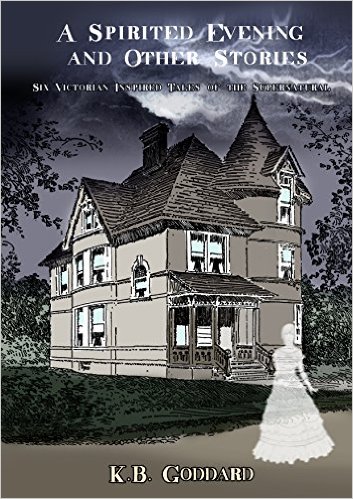
A Spirited Evening and Other StoriesEvery writer sometimes comes to a point where it’s difficult to create. What rituals or tips do you utilize to work around those creative blocks?

I’ll let you know when I figure it out!

Out of your published stories, do you have a personal favorite?

Probably “Reflections on a Malady.” It was my first Victorian ghost story and the one that started it all.

What projects are you currently working on, and what else do you have slated for the next year?

At the moment I’m between projects. I’m also still studying with the OU so that is taking up a lot of my time at the moment. But I’m hoping to start getting some planning done towards my next ghost story collection soon. There are a couple of other things hopefully on the horizon but I don’t want to jinx anything!

Big thanks to K.B. Goddard for being part of this week’s author interview. Find her at her author site as well as Twitter and Facebook!  Any links you’d like to share?

Happy reading!

A Shadowy Presence: Interview with Mark Nixon

Welcome back to another author interview! This week, I’m thrilled to spotlight editor and writer Mark Nixon. Mark is the purveyor of the awesome Shadows at the Door website that features a variety of horror stories in both the classic and modern veins. I’ve been one of the fortunate authors to work with Mark on several occasions in the past, and the collaborations have always been incredible and rewarding experiences.

Right now, Mark is in the throes of expanding Shadows at the Door to a full illustrated hardback anthology, which you can support over at Kickstarter. He took a quick detour from promotion to talk with me about the future of the site as well as his own burgeoning writing career.

A couple icebreakers to start: when did you first decide to become a writer, and who are some of your favorite authors?

Mark Nixon

I actually only started writing a few years ago, I’ve learnt a great deal in that time and it’s been a really interesting and fun process to evolve and find my voice. I consider myself self taught, but feedback has always been the best teacher I could have asked for. My favorite authors include M.R. James, Stephen King, Susan Hill, Neil Gaiman and Washington Irving.

Tell me about the genesis of Shadows at the Door. Why did you create the site, and what are your hopes for its long-term future?

After I finished my first short story “An Unwelcome Guest,” I just wanted to share it with my friends so I created the website. Quite soon the story reached more people than I’d anticipated and the site become quite popular. After I finished another story, I decided it would be a great idea to maintain the site as an online library of new ghostly horror and I opened it up for submission, and it took off from there! Quite soon I realized I had something special on my hands and now I’m keen to expand Shadows at the Door into a full independent publisher.

When selecting a story for the site, are there specific features you’re looking for, or is it simply a certain feeling you hope to experience by the end of reading a tale?

My passion is the modern ghost story, or Pleasing Terrors as they are often called by fans of the genre, so I usually look for stories that fit that bill. Subtle, creeping stories with plenty of atmosphere and/or an emotional wallop, like your work! However if a different kind of story is good enough to catch my eye, I publish it. I recently published a story with no supernatural element at all but it was just too good to pass on.

Shadows at the DoorWhat inspired you to expand Shadows at the Door from an online-only venue to an anthology?

I’ve been inspired by the positive reaction and loyal readership of the site, and as a life long bibliophile, it’s the natural way to go. There’s something quite special about owning a beautifully made book!

You are also a writer yourself. Do you have any specific habits as an author (e.g. writing every day, only writing certain times of day, etc.) that help to keep you on track?

I always dread this question! Like most writers, I work full time and then running the site takes up a lot of time too.  I also recently married, so I’m still working all aspects of my life around schedules and maximizing it as best as possible. At the moment, I tend to write on evenings every other day for one to two hours, I’m my own worst critic too, so I have this terrible habit of backtracking and editing as I go, so my first draft is essentially my second draft before the big third edit.

Out of your own published stories, do you have a personal favorite?

I’m really proud of my story in the upcoming anthology “Quem Infra Nos,” but out of my existing published stories it’s “Silent Warnings.” I loved writing the protagonist and it’s one who has resonated with readers. There’s a bit of mystery that plays out nicely and it was the first story when I really felt confident exploring deeper levels of characters and motivations.

Big thanks to Mark Nixon for being part of my author interview series! Find him at Shadows at the Door, and on Twitter. Also, please consider lending your support to the Shadows at the Door Kickstarter. Keep awesome horror fiction alive!

Happy reading!

Perfectly Prolific: Interview with Edward Ahern

Welcome to another author interview! This week, I’m happy to spotlight Edward Ahern. Edward is an accomplished writer who’s had work appearing in dozens of anthologies and journals, including See the Elephant, Flapperhouse, and Bewildering Stories.

A few months back, Edward and I discussed his trajectory as a writer as well as the tips he can share for other scribes out there.

A couple icebreakers to start: when did you first decide to become a writer, and who are some of your favorite authors?

Edward AhernI’ve been a writer of sorts since I was sixteen and started doing obits for a weekly. Degree in journalism, and a year as a reporter at the Providence Journal before needing more money to handle a pregnant wife, so wrote intelligence, marketing and sales reports (frequently fiction) until retirement. Was sixty-seven before resuming writing, I mostly read genre ( including about 25,000 words/week reviewing for Bewildering Stories) and general or realistic fiction rather than literary. Having just typed that, I have love/hate relationships with David Foster Wallace and James Joyce.

At over sixty short stories, you are widely published in the speculative fiction field. What advice can you offer for new writers trying to break into the literary world?

The biggest mistake I made in trying to get initially published was in thinking that my still rough draft was good enough for the top of the market. After a great many rejections I would in frustration send the story to the bottom of the market, which would, more often than not, accept it. I finally realized that I needed to re- and re-write ruthlessly to get a story in shape for a top publication. And even then the top tier rejects me a lot.

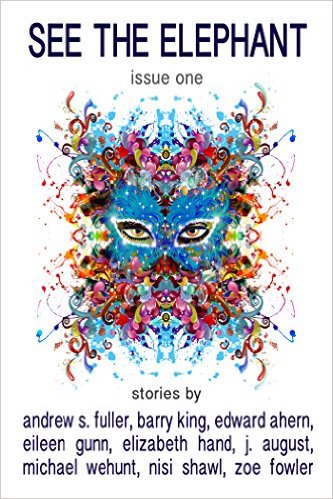
See the ElephantSince you have heretofore written more short fiction, how did your process change (or stay the same) when you wrote your novella, The Witches’ Bane?

I’ve now had over eighty stories and poems published, most also reprinted. I write terse, and usually short, so when I got into the novella I felt like I was trying to eat too much ice cream. Now have the same stomachache working on a novel. I often take a little break and write a short poem or two before getting back into the double chocolate.

Out of your published pieces, do you have a personal favorite?

Personal favorites: Hmmm. Literary stories it would have to be “The Cottage” which won a couple awards. Fairy tales “Care and Feeding” which has been published five times so far. There’s a lot of fantasy, but maybe “Listen to the Deaf Man Sing” which will be out shortly at Metaphysical Circus. Sci-fi, one of my earliest stories “The Body Surfer” (four pubs) Horror would have to be a quiet little piece, “The Dog Fisherman.”

Any last tips you’d like to share?

I absolutely swear by Duotrope, it’s more than worth the $50/year. And relationships with editors who’ve accepted a story or two are gold. They already know and like your stuff.

Big thanks to Edward Ahern for being part of this week’s author interview. Find him online!

Happy reading!

Sweet as Gingerbread: Interview with M. Brett Gaffney

Welcome back to another author interview! This week, I’m pleased to present M. Brett Gaffney! Brett is the art editor for the consistently lovely Gingerbread House Literary Magazine, an online publication featuring the best and most beautiful in fairy tales, magic realism, and other works of the fantastic. Brett is also an author in her own right with poetry published at such places as Stone Highway Review, Cactus Heart, and Penduline.

Recently, Brett and I discussed her work at Gingerbread House as well as lots of other great tidbits (Island of the Dolls, anyone?).

A couple icebreakers to start: when did you first decide to become a writer, and who are some of your favorite authors?

M. Brett GaffneyI grew up making stories, filling notebooks with poems and stories, even fan-fiction. But I think I decided to become a serious writer when I was in college. I was an English major taking a poetry course at Stephen F. Austin University in Nacogdoches, Texas. My then professor, now friend and chief editor of Gingerbread House, Christine Butterworth-McDermott took an interest in my poetry. When she first suggested I submit my work for publication, I thought, oh man, maybe I’m a writer. It’s weird how powerful others’ validation is with regards to the things we do, but I respected her (and her husband, John McDermott, creator of the BFA program in Creative Writing there) so much that her encouragement gave me the boost I needed to really work at it. The writers I read then are still some of my favorites today: Kristin Naca, Kim Addonizio, Patricia Smith, Marisa Silver, Stewart O’ Nan, Toby Barlow… And then some newer favorites: Jamaal May, Ada Limon, Ross Gay, Tarfia Faizullah, Aimee Bender, Benjamin Percy, Rick Yancey… I’m also reading a lot of nonfiction right now, books about Jonestown and American “murder houses” at the moment.

You are the art editor at Gingerbread House Literary Magazine. How did you become involved with the publication, and what is your process in curating such a lovely and effective collection of art for the site? 

During my last year at SFA, Christine and I talked about starting a literary journal catering specifically to fairy tales. And then two years later during my MFA program at Southern Illinois, we made it a reality along with Kay Winfield, our web editor, and Kayla Haas, our fiction editor. We knew we wanted to pair the poems and stories with some images but the art curation truly started while putting together our third issue. I was a fan of photographer Brooke Shaden’s work and then realized one of her pieces would pair great with a poem we were publishing. So I emailed her for permission and she said yes. Ever since, I’ve adopted the title of art editor and commenced an ongoing search of social media, deviant art, and other journals for artists that embody the kind of work we look for: strange, surreal, and of course fairy-tale-esque. I’m actually in the midst of finding art for our February issue. We of course choose our literature first then search for the right artistic pairing; it’s always an exciting challenge. And now I feel we’ve become a journal that prides itself on our visual aesthetic just as much as the literary work. It’s a beautiful hybrid. This month (February) will mark our seventeenth issue.

Gingerbread House LitAs a poet, do you have a specific process behind your work, or do you allow each poem to develop organically in its own way?

I think each of my poems requires its own process and most of the time it is very organic, usually drafted initially by a feeling or image. Though some require research, like poems about Waverly Hills Sanatorium, and that process is a bit more methodical. I find the facts I want to tether the poem to and then work around them. Though I have to be careful not to rely on research or else the poem starts to feel too loaded down with history, more like a textbook. Most of the time it’s just me, the laptop, and a bit of music. The other night I started writing to Disturbed’s cover of “The Sound of Silence” by Simon and Garfunkel on a loop. What I got out was raw and powerful but now I just need to go back to it and see which lines are really good and which ones are mostly tears.

All of your writing is captivating, but my own favorite is your poem, “La Isla de las Muñecas, Xochimilco, Mexico.” What inspired you to write about the Island of the Dolls, and have you ever visited the infamous island yourself?

Thank you! I wish I could say I’ve visited the island. Alas, I’ve only watched what few documentary segments I could find about it. I first read about Xochimilco on some website, probably Cracked, as one of the most haunted locations in the world. But then of course I needed to know more, get as close to the truth of the place as I could. The images of the dolls alone are terrifying but this one man’s dedication to the collection is what really captivated me. So I carved out a story for him and tried my best to both unsettle my audience and also pull them in, make them want to leave a doll offering themselves. That’s also one of my first poems to be published so it holds a special place in my heart.

What upcoming projects are you working on?  

I have a list, haha. But the two I keep coming back to are my poetry collections about Waverly Hills Sanitorium in Louisville, Kentucky and my time working as an actor at the Dent School House, a haunted house in Cincinnati, Ohio. Waverly has captured my attention for about six years now and I’ve written thirty plus pages of poetry on the hospital, its history and its ghosts. My Dent poems are newer, as I’ve only worked two Halloween seasons there. So far, the poems I’ve drafted look at the haunted house from behind the scenes. For example the one I’m working on right now specifically deals with my getting punched in the face by a customer I successfully scared.

Huge thanks to M. Brett Gaffney for being our featured author this week. Find her online, and keep an eye on Porkbelly Press for updates on the upcoming release of Brett’s chapbook, “Feeding the Dead.”

Happy reading!

Weird and Wonderful: Interview with Kristi DeMeester

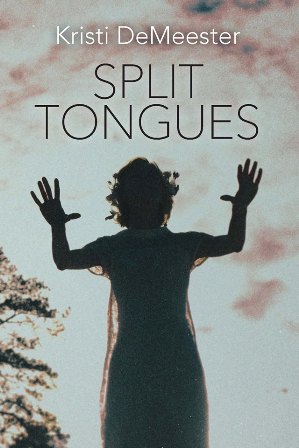
Welcome back! This week, I turn a spotlight on purveyor of horror and the weird, Kristi DeMeester. Kristi is the author of numerous short stories as well as the chapbook, Split Tongues. Her fiction has been featured widely in publications such as Black Static, Shimmer, and Three-Lobed Burning Eye among others.

Recently, Kristi and I discussed where she’s been as a writer and where she’s planning to go (and she even hinted at her forthcoming and highly anticipated short fiction collection).

A couple icebreakers to start: when did you first decide to become a writer, and who are some of your favorite authors?

Kristi DeMeesterWhen I was younger, I was always more of a reader than a writer. I’m not the person who can say “Oh, I wrote my first story when I was six.” But I ingested every book I could get my hands on. I did try to write a novel when I was eleven. I think I got three spiral bound pages in and stopped. I titled it Who Made You the Boss Anyway. Yeah. I didn’t start writing seriously until I was 24. When I left my MFA program two years later, I started writing horror.

Some of my favorite authors are Flannery O’Connor, Joyce Carol Oates, Shirley Jackson, Livia Llewellyn, Laird Barron, Michael Wehunt, Poppy Z. Brite, John Langan, I could go on and on.

In only a few years, you’ve already reached so many milestones in your career, with stories appearing in Black Static, Shimmer, The Dark, and Year’s Best anthologies. When it comes to your short fiction, what’s left on your to-do list? Are there still publications out there you’re eager to crack?

I’d love to have a story in Nightmare, Apex, and Cemetery Dance. And, of course, I’d like to be on a Datlow or Guran list at some point.

As I read multiple stories from authors, I always love to search for the threads that connect the writer’s world. One primary theme I’ve noticed that permeates your work is your frank and nontraditional exploration of motherhood. You’ve confronted the subject from various angles: a mourning mother looking for something transcendent in “Like Feather, Like Bone”; unlikely mother figures searching the hungry darkness in “All the World When It Is Thin”; a lost mother who must be retrieved in “To Sleep in the Dust of the Earth”; and a predatory mother who offers her child as a sacrifice in “The Marking.” When crafting these stories, did you set out specifically to explore a certain aspect of motherhood, or did that develop naturally as you wrote? Also, it can sometimes be difficult to get editors to pay attention to narratives that plumb the depths of “the monstrous feminine.” Have you experienced any resistance when writing such female-focused stories?

Motherhood is a topic I come back to because I’m constantly trying to work out my own issues with it. What it means to be the daughter of a terrible mother; how frequently daughters don’t recognize how much of themselves has been sacrificed in the face of a self absorbed mother; how that might ultimately affect my own abilities to mother and the fear of ultimately turning into the monstrous thing my own mother was. Because even though I’ve separated myself from that abuse and toxicity, she’s still a part of me. Lurking somewhere under my skin and lying wait in my blood. And I think too frequently, women have a lot of pressure to be this selfless, giving fountain of love and are expected to lose themselves in their children. I have a lot of fear about that as well because I can’t do that, and the associated guilt is enough to drown, and I wonder if I’m going to turn into her no matter how hard I rail against it. Much of my fiction centers on those fears because I think it’s a dark underbelly that women often try to ignore. I know that I have tried.

I haven’t experienced overt resistance necessarily. No one has told me explicitly that my story would be a hard sell. But some of my stories that deal with the darker aspects of femininity have been tough sells. “The Marking,” which appeared in Three-Lobed Burning Eye and which will be reprinted in Year’s Best Weird Fiction Volume 3, was rejected eight times before it sold. It’s one of the more intense stories I’ve written dealing with mother/daughter relationships. I’m still in shock that it was selected for Year’s Best Weird.

Congratulations on the recent release of your chapbook, Split Tongues! What was the process behind launching the project through Dim Shores, and was there anything about putting together your first chapbook that was particularly surprising or challenging?

Split TonguesThank you so much! I was so excited when Sam reached out to me. I didn’t have anything at the time that was the length he was looking for, but I had an idea in the back of my mind about a teenage girl and speaking in tongues. I sat down the same day he emailed me and started “Split Tongues.” A week and a half later, it was finished, and I sent it to him. After that everything came together beautifully. I was so impressed with how professional and courteous Sam was. Working with him was a dream. Anytime an editor allows the author to help with design and artwork, it’s a phenomenal experience, and I was thrilled when I found Natalia Drepina, whose photography appears in the book. Thankfully, Sam liked her work, too. It was a lovely experience.

Looking forward in your career, you’ve mentioned in previous interviews that you have your first collection of short fiction in the works. What can you reveal about that project at this point? Have the stories been selected, and can we expect some never-before-released pieces in the table of contents?  

Unfortunately, I can’t reveal much. The stories have all been selected, but there may be one or two never released pieces that will be added.

Out of your published stories so far, do you have a personal favorite?

It’s titled “The Beautiful Thing We Will Become” (and will appear in Word Horde’s upcoming Eternal Frankenstein anthology).

Tremendous thanks to Kristi DeMeester for being this week’s featured author! Find her at her author site, and pick up a copy of Split Tongues, while you still can!

Happy reading!